Leave Your Message
-
Exhibition
-
Phone
-
E-mail
-
Whatsapp
Contact
Choosing the right Bucket Hat Cord for bulk buying requires more than comparing prices. The cord affects comfort, fit, appearance, and customer satisfaction. A weak cord may stretch after repeated use. A stiff cord can irritate the wearer’s neck. Small details matter.
In practical sourcing, I examine the cord’s material, diameter, elasticity, length, and finishing. Polyester often offers good durability and color stability. Cotton can provide a softer, more natural touch. However, material labels alone are not enough. Request samples before approving a large order. Pull the cord repeatedly. Test the stopper with different hat fabrics. Check whether the cord frays near the end caps.
The supplier’s production experience also deserves attention. Ask for clear specifications, inspection procedures, and consistent sample records. Reliable suppliers should explain their minimum order quantity, packaging method, lead time, and replacement policy. Color matching needs care, especially for black, beige, and custom shades. Photos may hide small differences.
Bulk buying can expose weaknesses quickly. I once underestimated stopper quality, and a minor fitting issue became a larger packaging problem. That mistake changed my inspection checklist. Still, no checklist is perfect. Weather, storage, and handling may affect performance after delivery. A thoughtful buyer should leave room for testing, feedback, and adjustment.
Look beyond the lowest quotation. Compare total value, including defect rates, communication, shipping protection, and quality control. A slightly higher unit cost may reduce returns and production delays. The best choice is not always the most fashionable cord. It is the one that performs consistently across thousands of hats. That standard creates a more dependable buying decision.
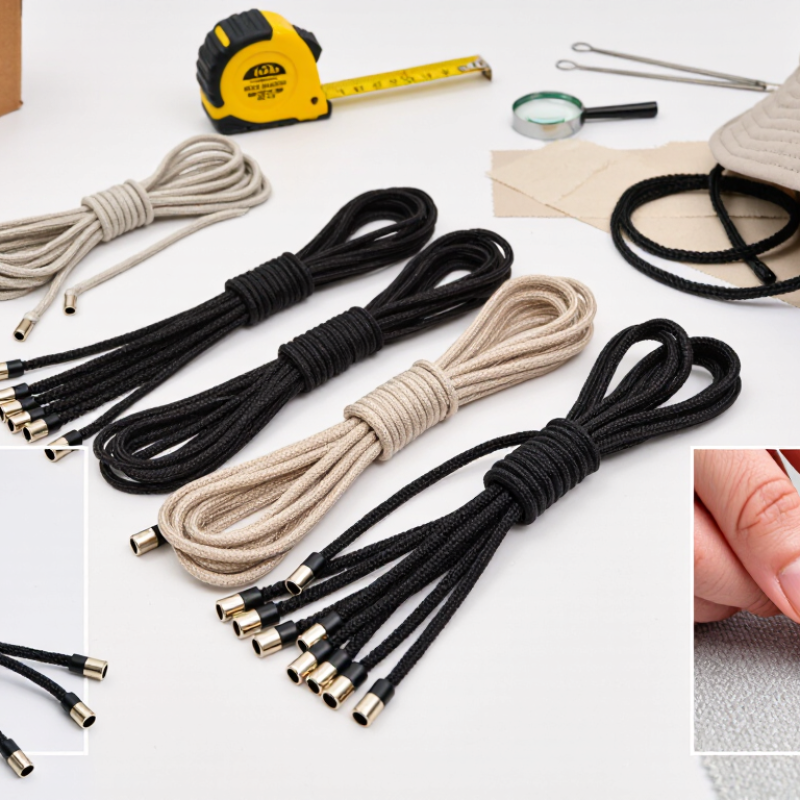
How to Choose the Right Bucket Hat Cord for Bulk Buying?
Before ordering in bulk, define how the bucket hat cords will be used. Cords for outdoor work need stronger fibers and secure adjustment locks. Fashion accessories may require softer textures, lighter weights, and cleaner color matching. Children’s activities demand careful sizing and smooth finishes. The purpose changes the specification.
For hiking, fishing, and travel, choose cords that resist moisture, repeated pulling, and surface abrasion. A rounded polyester cord often offers practical durability and stable shape. For promotional events, focus on consistent color, comfortable wear, and easy attachment. Uniform quality matters more than a low unit price. Small differences become obvious across hundreds of pieces.
Check the cord length with the actual hat pattern, not a product photo. I once underestimated the adjustment range, and the finished cords felt restrictive. That mistake changed my sampling process. Request samples, test the cord with real hats, and inspect the stopper after repeated adjustments. Some cords look excellent but loosen during movement. This detail deserves attention. Also review packaging, color tolerance, and delivery consistency before placing a large order. A reliable supplier should explain material content, testing methods, and acceptable production variation clearly. Yet no sample predicts every outcome. Leave room for practical feedback.
| Main Use | Typical Wearing Conditions | Recommended Cord Material | Suggested Cord Diameter | Typical Cord Length per Hat | Recommended Adjustment System | Key Bulk-Buying Requirements |
|---|---|---|---|---|---|---|
| Everyday Casual Wear | Urban use, commuting, shopping, and general outdoor activities with moderate movement. | Polyester or nylon cord; both provide good abrasion resistance and dimensional stability. | 2.0–3.0 mm | 65–85 cm | Lightweight plastic or coated-metal cord lock. | Prioritize comfort, low weight, smooth texture, and color consistency across the production batch. |
| Hiking and Trekking | Windy trails, uneven terrain, extended walking, and repeated adjustment during movement. | High-tenacity polyester or nylon; braided construction is suitable for improved strength and flexibility. | 2.5–3.5 mm | 75–95 cm | Locking cord toggle with a secure spring mechanism. | Request tensile-strength and abrasion-resistance test data. Confirm that the cord lock remains secure after repeated adjustment. |
| Fishing and Waterside Activities | Exposure to moisture, splashes, sunlight, salt air, and frequent outdoor handling. | Solution-dyed polyester or marine-suitable nylon with water-resistant treatment. | 2.5–3.5 mm | 75–95 cm | Corrosion-resistant plastic or stainless-steel-compatible components. | Check colorfastness, moisture resistance, salt-spray performance, and drying behavior before placing a large order. |
| Travel and Tourism Merchandise | Frequent packing, unpacking, souvenir use, and varied climates. | Polyester or recycled polyester cord with a soft braided surface. | 2.0–3.0 mm | 65–85 cm | Compact plastic cord lock with a simple one-hand adjustment. | Select a versatile color range, compact hardware, and packaging that prevents tangling during transport and storage. |
| Children’s Outdoor Hats | Playground use, school trips, family outings, and active movement. | Soft polyester or nylon with smooth edges and a flexible hand feel. | 1.5–2.5 mm | 55–75 cm | Lightweight, rounded cord lock designed to reduce snagging risk. | Review age suitability, component safety, pull strength, and the finished hat design. Avoid sharp edges and unnecessarily long free-hanging ends. |
| Workwear and Uniform Hats | Regular use, repeated washing, physical work, and long service periods. | High-strength polyester or nylon with strong resistance to abrasion and laundering. | 2.5–3.5 mm | 75–95 cm | Durable locking toggle or stitched adjustment system. | Confirm wash-cycle performance, color retention, seam strength, and compatibility with the uniform’s care instructions. |
| Promotional and Event Giveaways | Short-term campaigns, outdoor events, festivals, sports activities, and high-volume distribution. | Cost-efficient polyester or polypropylene cord, depending on the required appearance and strength. | 2.0–3.0 mm | 65–85 cm | Standard plastic cord lock or fixed stitched loop. | Balance unit cost with acceptable comfort and appearance. Confirm logo-color matching, sample approval, and carton quantity before production. |
| Fashion and Decorative Styling | Style-focused use where the cord functions as a visible design element rather than only a retention accessory. | Waxed cotton, polyester, braided cotton, or decorative mixed-fiber cord. | 2.0–4.0 mm | 65–90 cm | Metal bead, decorative stopper, or color-matched cord lock. | Evaluate surface texture, fraying resistance, color matching, hardware finish, and the visual consistency of the entire batch. |
| Rain and Sun Protection Hats | Outdoor exposure where the hat must stay positioned during wind, rain, or prolonged sunlight. | Water-resistant polyester or nylon with UV-resistant coloration. | 2.5–3.5 mm | 75–95 cm | Secure locking toggle with a smooth, weather-resistant finish. | Test cord recovery, colorfastness after UV exposure, moisture resistance, and the stability of the cord attachment points. |
| Premium Outdoor Collections | Higher-end retail products requiring refined appearance, comfort, durability, and consistent finishing. | Fine braided polyester, recycled polyester, nylon, or carefully selected natural-fiber cord. | 2.0–3.0 mm | 65–90 cm | Low-profile, color-matched, or metal-finish adjustment hardware. | Use pre-production samples to check hand feel, hardware noise, attachment quality, shade consistency, and packaging presentation. |